Table of contents:
In many industrial facilities, bulk material handling takes place in environments where the risk of explosion is not a remote hypothesis but a real possibility. Fine dusts, flammable vapors, or combustible mists are part of everyday operations in sectors such as mineral processing, the chemical industry, fertilizers, or animal nutrition. In these contexts, the design of conveying equipment cannot be limited to moving product from one point to another ; it must do so with absolute safety guarantees.
This is where ATEX certification (Atmosphères Explosibles) comes into play. It is an essential requirement for screw conveyors, belt bucket elevators, and chain conveyors operating in areas with explosion risk. Understanding what ATEX design really involves and how it applies to each type of equipment is key to protecting people, facilities, and the production process itself.
What is an explosive atmosphere and why it condition equipment design
An explosive atmosphere is created when three very specific elements coincide: air, a flammable substance (dust, gas, vapor, or mist), and an ignition source. In bulk material handling systems, these three factors can occur relatively easily if the equipment is not properly designed.
The purpose of ATEX regulations is precisely to prevent conveying equipment from becoming an ignition source. To this end, European legislation establishes two key directives: 2014/34/EU, focused on equipment and protective systems, and 1999/92/EC, aimed at protecting workers in areas with explosion risk.
In the case of dust, areas are classified as Zone 20, 21, or 22, depending on the frequency and duration of the presence of an explosive atmosphere. This classification directly affects equipment design, the materials used, mandatory sensors, and the selection of each component. There is an important point here: ATEX certification does not only apply to the conveyor as a whole but to each of its elements, from motors and gearboxes to sensors, bearings , and transmission systems.
ATEX-certified screw conveyors: full risk control
Screw conveyors are among the most common machines for handling bulk solids, but also require those requiring the greatest attention in ATEX environments. Continuous operation and material friction can generate static electricity buildup, a critical factor in atmospheres with flammable dust.
For this reason, ATEX screw conveyor design requires the installation of several earthing points (typically three to four) to ensure safe discharge of static electricity. In addition, all components must be conductive and individually ATEX-certified: gear motors, bearings, shaft seals and any element capable of generating heat or sparks.
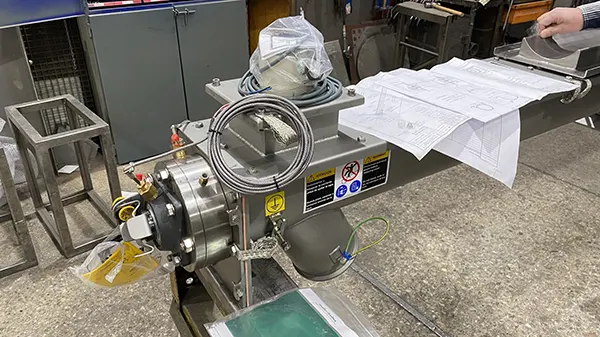
Zone classification determines the required level of protection. In Zone 22, rotation sensors and blockage sensors are mandatory, capable of detecting speed loss or obstructions that could cause material overheating. In Zone 21, requirements increase with the addition of temperature sensors on bearings and seals, ensuring that any abnormal temperature rise is detected before becoming a real risk.
Belt bucket elevators in ATEX environments: key specificities
Belt bucket elevators share many ATEX design principles with screw conveyors, but they also have specific features requiring particular attention. As vertical systems with moving parts and material return, control of static electricity and overheating is even more critical.
In an ATEX-certified belt bucket elevator, the use of antistatic conveyor belts and buckets made from antistatic plastics is essential, allowing controlled dissipation of electrical charges. The entire structure must be conductive and properly earthed to ensure continuous and safe discharge.
Instrumentation requirements again depend on the installation zone. In Zone 22, rotation sensors, blockage sensors and belt misalignment sensors are required to detect loss of alignment that could cause excessive friction. In Zone 21, temperature sensors are also added to bearings and other critical points, following the same criteria as screw conveyors. These measures not only protect against explosion risk but also provide much more precise monitoring of equipment condition, improving operational reliability.
Chain conveyors in explosive atmospheres: robustness with safety
Chain conveyors, (Redler type) commonly used in heavier applications or with abrasive materials, must also comply with ATEX requirements when operating in explosive atmospheres. In this case, technical guidelines are very similar to those applied to screw conveyors.
Static electricity discharge through earthing points is mandatory, as is the exclusive use of conductive and ATEX-certified components. Motors, gearboxes, sensors and transmission systems must each individually comply with the relevant regulations.
Once again, zone classification determines the minimum required instrumentation. In Zone 22, rotation and blockage sensors detect abnormal situations that could lead to temperature increases. In Zone 21, safety is reinforced with additional thermal sensors on bearings and other sensitive elements. The goal is always the same: to anticipate failure before it becomes an ignition source.
ATEX is not just regulation: it is design, foresight and experience
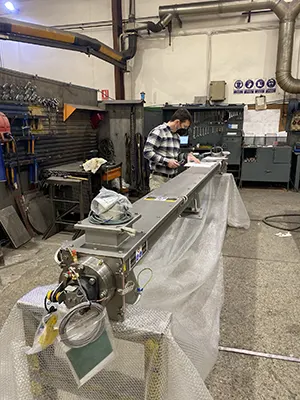
When these elements are correctly combined, the result is a safe, reliable system ready to operate in demanding environments without compromising productivity. Above all, it is a system that protects people and facilities from risks that leave no room for improvisation.
At Sinfimasa, we approach ATEX projects from this perspective: rigorous design, certified components and solutions tailored to each process. Because in explosive environments, safety is not an add-on, it is an essential part of the equipment itself.